

The Enemy Within Us
The line between good and evil runs through every heart

I have watched Platoon more times than I can count.
For years I thought it was a war film. Then I thought it was a film about Vietnam. Watching it again recently, I realised it is really about something much older and much closer to home.
It is about human nature.
Most people remember Sergeant Barnes and Sergeant Elias as opposites. Barnes is ruthless, pragmatic and terrifying. Elias is compassionate, thoughtful and principled. It is easy to watch the film and conclude that one represents evil and the other good.
I don't think that's quite right.
I think Barnes and Elias are two possibilities that exist inside every person.
We like to believe that evil is rare. That it belongs to monsters who are somehow different from us. History tells a different story. Wars, genocides and atrocities have never been carried out by a handful of comic-book villains. They have been carried out by ordinary people who found themselves in extraordinary circumstances.
Fear. Anger. Exhaustion. Loyalty to a group. The belief that the ends justify the means.
These things change people.
The uncomfortable truth is that most of us cannot honestly say what we would become if the rules disappeared tomorrow. We hope we would be Elias. We hope we would protect the innocent and stand against cruelty. But none of us can know for certain.
Perhaps that uncertainty is itself a kind of wisdom.
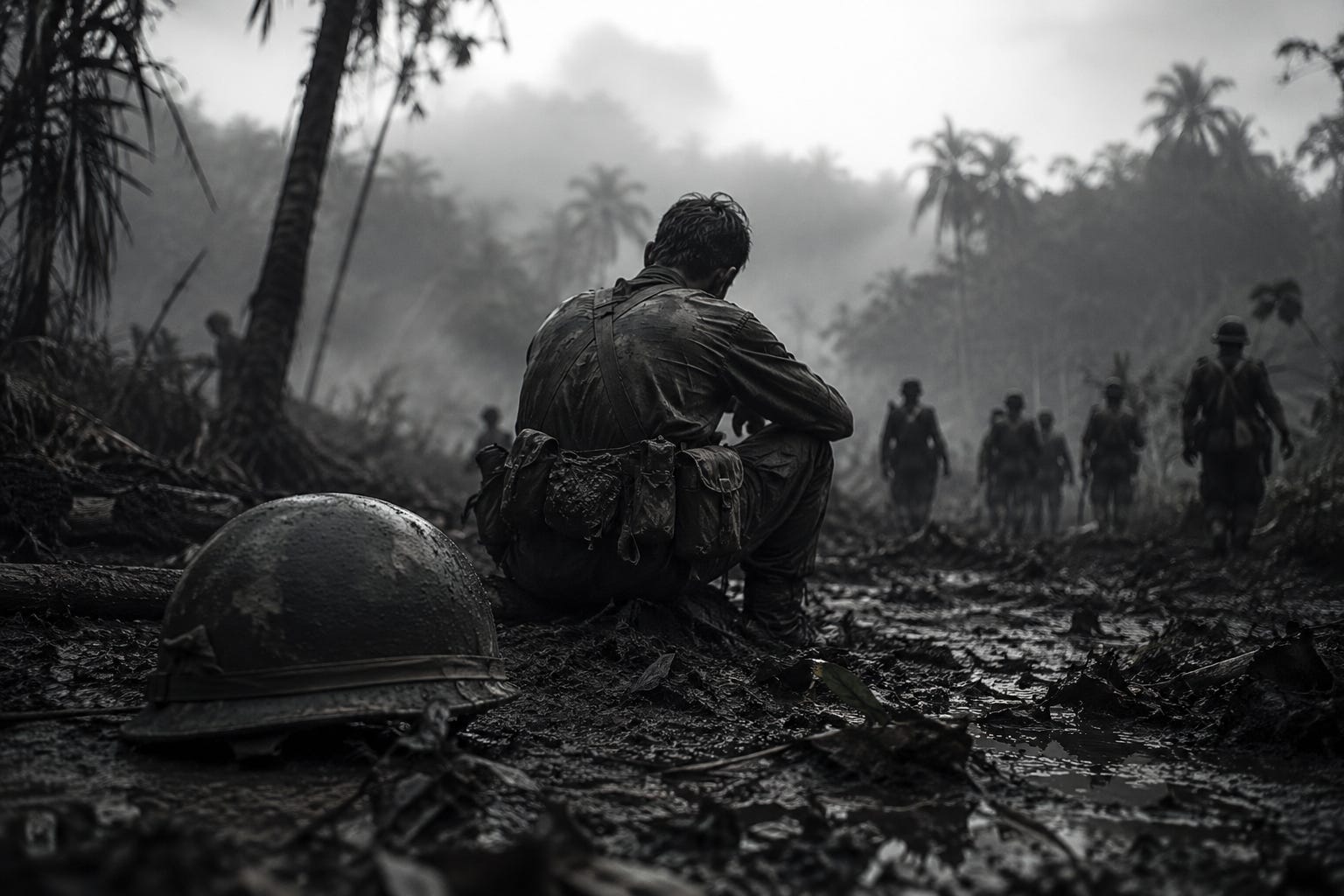
The older I get, the less I believe there are simply "good people" and "bad people." I think there are people who constantly choose integrity, and people who slowly surrender it. The line between those two paths does not run between races, religions, political parties or social classes.
It runs through every human heart.
That may be the real message of Platoon.
The platoon itself is diverse. Black, white, rich, poor, educated and uneducated men all stand on both sides of the moral divide. It does not matter where you come from. You can become a Barnes or an Elias.
What struck me most this time, however, was not the conflict between the two men.
It was how it ends.
Elias believes Barnes should answer for his crimes through the proper channels. He believes that even in war there must be law, justice and restraint.
Barnes believes the opposite. He is the law. If he decides someone deserves to die, they die.
Then Chris Taylor kills Barnes.
On the surface it feels like justice. Barnes murdered Elias and finally pays the price.
But look more closely.
Taylor does not defeat Barnes by following Elias's path. He defeats him by walking Barnes's path. He takes justice into his own hands. He becomes judge, jury and executioner.
In order to destroy the monster, he has to become capable of doing what the monster would do.
That is not a victory.
It is a tragedy.
The final narration says that they did not fight the enemy; they fought themselves, and the enemy was in them.
I think that is true of all of us.
Civilisation is not proof that the Barnes inside humanity has been defeated. It is the fragile agreement that, despite our capacity for cruelty, we will choose something better.
We build laws because vengeance is easy.
We build communities because fear isolates us.
We teach children kindness because selfishness comes naturally.
Every day, in ways both small and large, we decide which part of ourselves we will feed.
Perhaps that is the real war.
Not one fought in jungles or deserts or cities.
But the quiet battle between power and principle, between vengeance and justice, between Barnes and Elias.
And maybe the measure of a good life is not that we never feel the pull of darkness.
Maybe it is simply that, when the moment comes, we choose Elias anyway.
Stay Frosty.