

Selling Doubt
The Commercialisation of Distrust

The most valuable product in the modern world isn't medicine.
It's doubt.
Not the healthy kind. Not skepticism. Skepticism asks questions.
Doubt, in the modern economy, is a business model.
For most of history, companies sold trust.
Trust our bank.
Trust our car.
Trust our government.
Trust our medicine.
Then something changed.
The internet discovered that distrust is far more profitable.
Every pharmaceutical scandal, every government failure, every corporate lie became raw material. Thalidomide. Vioxx. The opioid epidemic. Real events. Real corruption. Real victims.
The public learned a dangerous lesson:
"They lied to us before."
And that lesson is true.
The problem is what came next.
"They lied to us before, therefore everyone else telling a different story must be telling the truth."
That doesn't follow.
Yet an entire economy has grown around that leap.
The wellness industry doesn't simply sell supplements.
It sells an identity.
It tells people they are awake while everyone else is asleep. That doctors are trapped by the system. That scientists are bought. That governments are hiding cures. That the truth lives in podcasts, YouTube channels and discount codes.
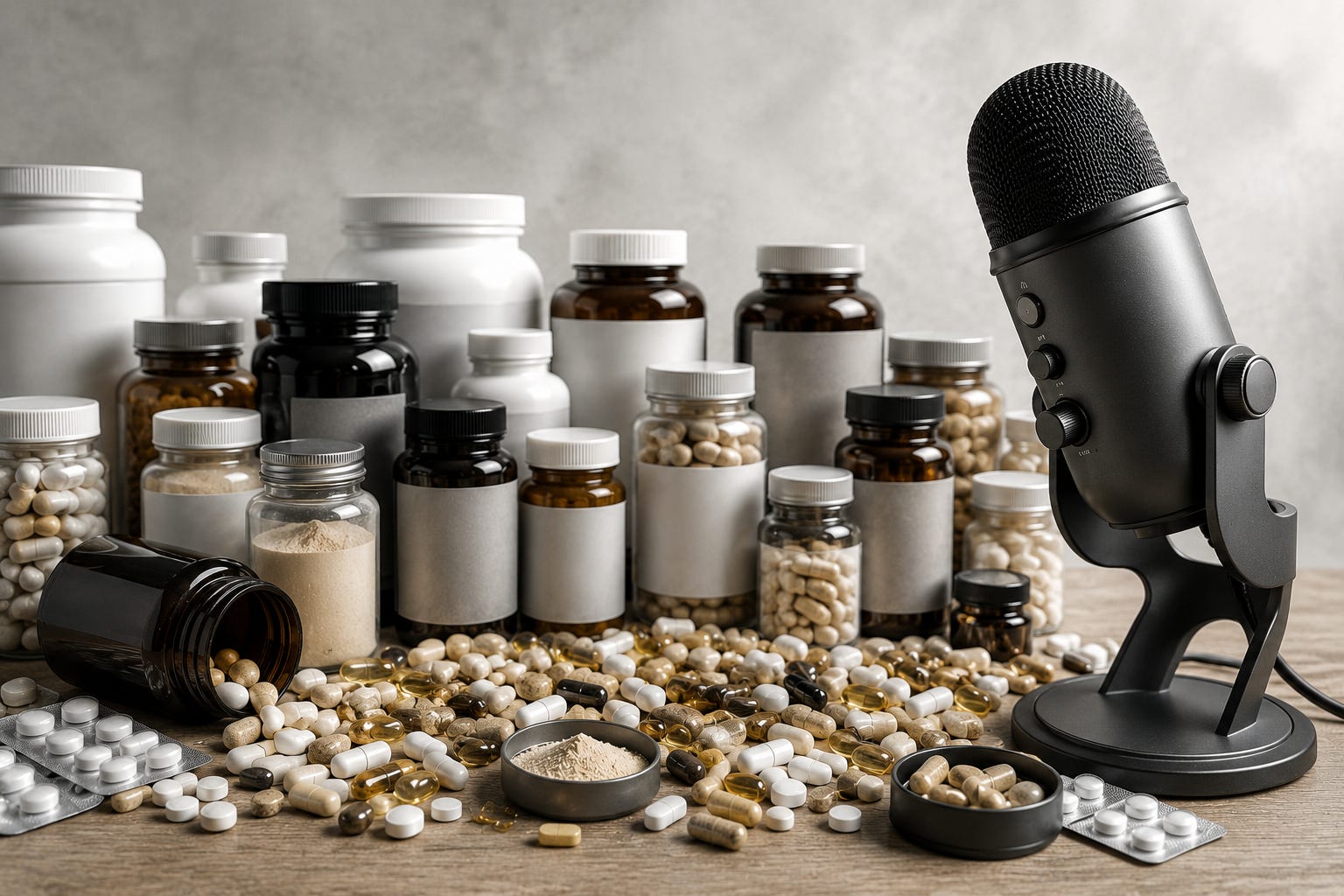
Distrust has become aspirational.
The irony is difficult to ignore.
Many of the loudest critics of Big Pharma are themselves building pharmaceutical-sized businesses selling powders, pills and capsules.
No requirement to prove efficacy.
No obligation to demonstrate outcomes before selling.
No years of expensive clinical trials.
Just marketing.
The old world sold authority.
The new world sells rebellion.
But rebellion itself has become a product.
This isn't to defend pharmaceutical companies.
They are commercial enterprises. They answer to shareholders. They have been caught lying, manipulating data and pushing products far beyond what was ethical. The opioid epidemic wasn't merely a regulatory failure. It was a moral failure.
Ordinary people trusted doctors, trusted the system, took the medication they were prescribed, and found their brains and lives quietly rewired by addiction.
That happened.
But there is another uncomfortable truth that rarely enters the conversation.
For every opioid scandal, there are millions of people alive because antibiotics exist.
Millions because insulin exists.
Millions because vaccines exist.
Millions because chemotherapy exists.
Millions because antivirals exist.
Millions because modern surgery exists.
The same system capable of corruption is also capable of extraordinary healing.
The internet rarely rewards that nuance.
It rewards certainty.
The supplement bottle, the beef tallow, the raw milk, the bone broth, the miracle detox protocol — these become symbols of identity as much as health.
It is remarkable how easily we suspend our own intuition.
None of us would believe that eating chicken skin would replace skin lost in a burn.
We would not expect a lamb shank to knit together a broken femur.
We understand, instinctively, that the body breaks food down into its basic components and rebuilds itself through infinitely more complex biological processes.
Yet wrap the same idea in the language of wellness, and suddenly cow collagen is imagined to somehow travel intact to a damaged gut lining and patch the holes.
The product isn't really collagen.
The product is the story.
The story says that nature has provided a simple answer, that doctors are overcomplicating things, and that the experts either don't know or don't want you to know.
That story is often far more powerful than evidence.
How did we arrive at a world where a medicine developed to treat genuine parasitic disease became, in the public imagination, a miracle cure for almost everything else?
How did we get to the point where a podcast host selling supplements can appear more trustworthy than an infectious disease specialist with a lifetime of clinical experience?
Perhaps the answer has very little to do with medicine.
Perhaps trust itself has become tribal.
People are not simply buying products.
They are buying belonging.
To accept conventional medicine is, for some, to join one team.
To reject it is to join another.
The supplement bottle, the wellness influencer, the conspiracy theory, the miracle cure — they become badges of identity.
And identity is remarkably resistant to evidence.
Some people have paid the ultimate price for that identity.
Parents refusing vaccines.
Patients delaying cancer treatment.
People dying from treatable infections because an internet personality convinced them antibiotics were poison.
Not because they were foolish.
Because they trusted someone.
That is the real tragedy.
The pharmaceutical industry commercialised medicine.
The wellness industry commercialised distrust.
Both are businesses.
Both make extraordinary amounts of money.
Both deserve scrutiny.
But only one of them has discovered that it doesn't actually need to prove the product works.
It only needs to convince you that everyone else's doesn't.
The supplement, the podcast, the detox, the discount code, the endless warnings that "they" are lying to you — these are all secondary.
The real product is the feeling that you have awakened.
That you are one of the few who can see through the illusion.
That you know what the doctors don't.
What the scientists won't admit.
What the media refuses to report.
That you beat Big Pharma.
That you beat the system.
That you are smarter than everyone else.
But perhaps that is the cleverest grift ever invented.
Because you didn't buy collagen.
You didn't buy bone broth.
You didn't buy a miracle detox.
You bought the feeling that you couldn't be fooled.
And the pills were just the receipt.
Stay healthy. Stay frosty.
The idea that people are buying belonging, not just products, felt especially true.
Well put, and so depressingly true.